Allergic Contact Dermatitis (ACD)
Delayed type-IV hypersensitivity reaction to a substance the immune system has been sensitised to. The hallmark presentation is an eczematous rash that mirrors the area of contact and recurs with re-exposure.

Services / Patch Testing
When a rash will not settle — on the hands, eyelids, face, scalp, or anywhere the skin meets the world — there is often a hidden contact allergen behind it. Patch testing identifies it. The MED1 Patch Testing Clinic applies the standard NC80 panel on Monday, reads it Wednesday, and finalises the interpretation Friday — all under specialist allergist supervision.
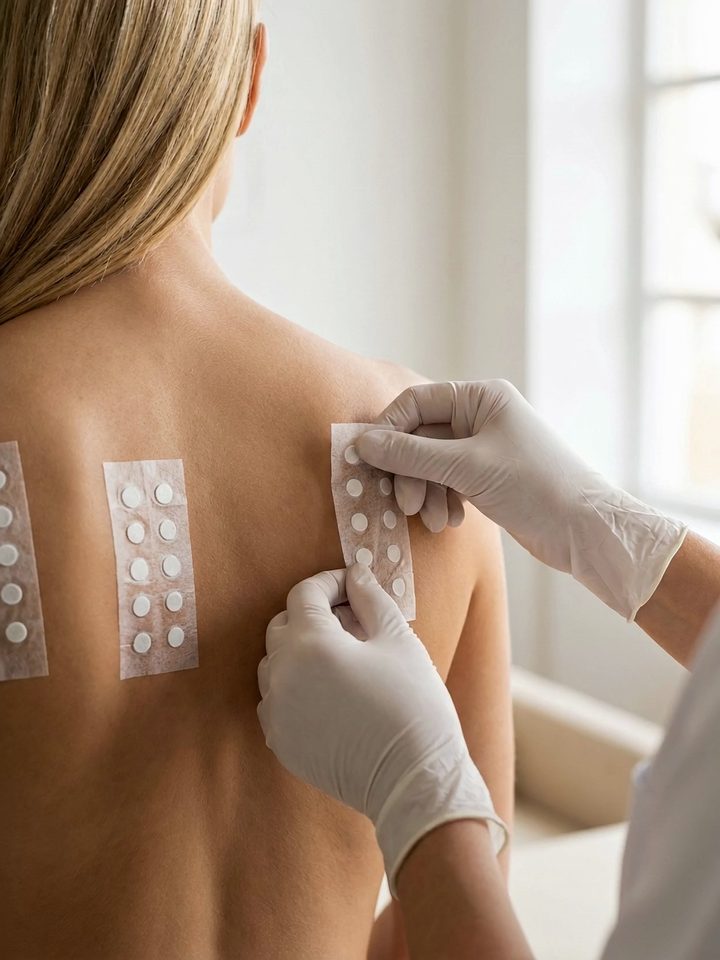
Patch testing identifies delayed-type, cell-mediated allergies — the kind that cause eczematous rashes hours to days after exposure. It is a different mechanism from the immediate, hive-causing allergies detected by skin prick testing. Patch testing is the only validated method to confirm allergic contact dermatitis and distinguish it from irritant contact dermatitis.
Standardised allergens are applied to the skin of the back under small occlusive chambers. The patches stay in place for 48 hours, then the skin is examined for early reactions. A second reading at 96 hours captures the later reactions that only develop after the immune system has had time to respond. The pattern of positive results — interpreted in the context of your history — identifies which substances to avoid and which products are safe.
Most patients arrive having tried multiple creams over months or years without a sustained answer. The point of patch testing is not to add another treatment. It is to find what has been causing the rash all along, so that the right avoidance unlocks the response that no topical alone could provide.
Patch testing is most useful when the clinical picture suggests a contact component — especially in dermatitis that is persistent, distributed in a suggestive pattern, or unresponsive to standard treatment.
Delayed type-IV hypersensitivity reaction to a substance the immune system has been sensitised to. The hallmark presentation is an eczematous rash that mirrors the area of contact and recurs with re-exposure.
Direct, non-immune skin injury from a chemical, soap, solvent, or repeated wet-work. Patch testing helps confirm an irritant rather than allergic mechanism and shapes avoidance accordingly.
Persistent or recurrent hand eczema — particularly in healthcare, food-service, hairdressing, cleaning, and construction work — where occupational exposures may be sustaining the inflammation.
Eyelid skin is thin and exposed to fingertip-transferred products. Common culprits include nail-polish chemicals, eye cosmetics, fragrances, preservatives, and contact-lens-solution components.
Reactions to moisturisers, foundations, shampoos, conditioners, body washes, and perfumes. Fragrance mixes and specific preservatives are among the most common positives on the NC80 panel.
Nickel, cobalt, and chromate sensitivity present as rashes under jewellery, watch backs, belt buckles, and clothing fasteners — and sometimes around dental work or orthopaedic implants.
Worsening rashes despite topical treatment can occasionally be a reaction to the topical itself — neomycin, bacitracin, or even corticosteroids in a small subset of patients.
Atopic dermatitis that has plateaued on standard therapy, or that shows new patterns of distribution, often benefits from patch testing to rule in or out a superimposed contact allergy.
Suspected sensitivity to dental restorations, joint replacements, or cardiac stents — where nickel, cobalt, chromate, or methacrylate exposure may be sustaining a periprosthetic inflammatory response.
Patch testing at MED1 is run on a standard Monday — Wednesday — Friday schedule. The longest visit is the first; the rest are brief.
Our trained nurse applies the NC80 allergen series to the skin of your upper back under standardised occlusive chambers. The application is painless and takes approximately 30 to 45 minutes. The patches are then taped securely and remain in place until your return visit on Wednesday.
The patches are removed by our nurse and the skin is examined by your allergist. Early-developing reactions — those appearing within 48 hours — are graded and photographed for the medical record. The visit takes approximately 20 minutes. Any reactions are explained to you in real time.
A second reading captures delayed reactions that only emerge at the 96-hour mark, which is when many true contact allergies show up. Your allergist interprets the complete pattern, identifies relevance to your symptoms, and provides a written allergen-avoidance plan with safe-product alternatives and a clear copy returned to your referring physician.
The North American Contact Dermatitis (NC80) panel was assembled by specialist dermatologists and allergists from the most commonly relevant contact allergens across cosmetics, occupations, medications, and everyday products. Additional allergens can be added based on specific exposures, occupations, or suspected triggers.
Nickel sulphate, cobalt chloride, potassium dichromate — behind reactions to jewellery, watch backs, belt buckles, leather, dental work, and orthopaedic hardware.
Fragrance Mix I & II, balsam of Peru, hydroxycitronellal, and related markers — common in perfumes, lotions, soaps, and many "unscented" products that still contain masking fragrances.
Methylisothiazolinone, formaldehyde and formaldehyde-releasers, parabens, quaternium-15 — widespread in cosmetics, wet wipes, shampoos, household cleaners, and paints.
Thiuram mix, mercapto mix, carba mix — the chemicals that make latex gloves, elastic bands, and rubber-soled footwear sometimes cause persistent hand or foot dermatitis.
Paraphenylenediamine (PPD), cocamidopropyl betaine, and related compounds — relevant to hair dye reactions, scalp dermatitis, and shampoo or conditioner intolerance.
Neomycin, bacitracin, and corticosteroid markers — the medications themselves can occasionally be the cause of a rash that does not improve, or worsens, with treatment.
Colophonium (rosin), propolis, sesquiterpene lactone mix, balsam of Peru — from natural products, "clean beauty" formulations, and certain occupational exposures.
Methacrylates, epoxy resin, p-tert-butylphenol formaldehyde resin, disperse dyes — relevant to nail technicians, dental and medical staff, textile reactions, and acrylic nail dermatitis.
Benzophenone-3, octocrylene, and related UV-absorbing chemicals — behind photo-distributed dermatitis on the face, neck, and forearms that flares after sunscreen application or sun exposure.
A few small adjustments in the week before Monday's appointment help ensure accurate, interpretable results.
Patch testing is the diagnostic gold standard for identifying allergic contact dermatitis. Small amounts of standardised allergens are applied to the skin of the back under occlusive patches. The skin is examined at 48 hours and again at 96 hours for delayed-type reactions, which reveal which substances the immune system has become sensitised to.
Skin prick testing detects immediate IgE-mediated allergies — hay fever, food allergy, anaphylaxis triggers — and gives results within 15 minutes. Patch testing detects delayed cell-mediated allergies that cause eczematous rashes, hand dermatitis, and contact reactions. Results emerge over several days because the immune response is slower.
The NC80 is the standard North American Contact Dermatitis panel containing the 80 most common contact allergens. It covers metals, fragrances, preservatives, rubber accelerators, hair-care chemicals, topical medications, plant allergens, and other categories. Additional allergens specific to a patient's occupation or product exposures can be added when indicated.
The full process spans one week and three short clinic visits. Patches are applied on Monday by our nurse, removed and read on Wednesday by your allergist, and read a second time on Friday with full interpretation. The Monday application is the longest visit at approximately 30 to 45 minutes.
Brief showers below the neck are fine, but the patches and the test area must stay completely dry from Monday application until Wednesday removal. After Wednesday, the back may be washed gently but should not be scrubbed. Heavy exercise and sweating should be avoided throughout the week as sweat can dislodge patches and affect results.
Systemic corticosteroids — including oral prednisone — should be discontinued for at least 7 days before testing, as they suppress the delayed immune response. Topical steroids on the back must also be stopped for 7 days. Antihistamines, unlike with skin prick testing, do not interfere with patch testing and can be continued.
No. The patches are painless to apply and remove. Some patients feel mild itching at positive reaction sites as the test develops — that itch is part of the reaction we are looking for and confirms the immune response. The skin returns to normal within a few days of the final reading.
Each positive result is reviewed in the context of your symptoms and product exposures to determine whether it is clinically relevant or an incidental sensitisation. For relevant positives, you receive a written allergen-avoidance plan, lists of safe and unsafe product ingredients, and where appropriate, suggested alternative product brands.
Yes. A referral from your family physician, nurse practitioner, or other healthcare provider is required for the OHIP-covered specialist consultation. Referrals may be sent by fax, email, or Ocean eReferral. After the initial consultation, the allergist will determine whether patch testing is indicated and schedule the three-visit testing series.
Yes. Patch testing can be performed in children when there is a strong clinical suspicion of contact allergy, particularly in cases of persistent eczema that has not responded to standard treatment. The same NC80 panel is generally used, applied to a portion of the back appropriate to the child's size.
Have your primary care provider send us a referral by fax, email, or Ocean eReferral. We schedule the initial consultation first; the three-visit patch-testing series follows after the assessment.